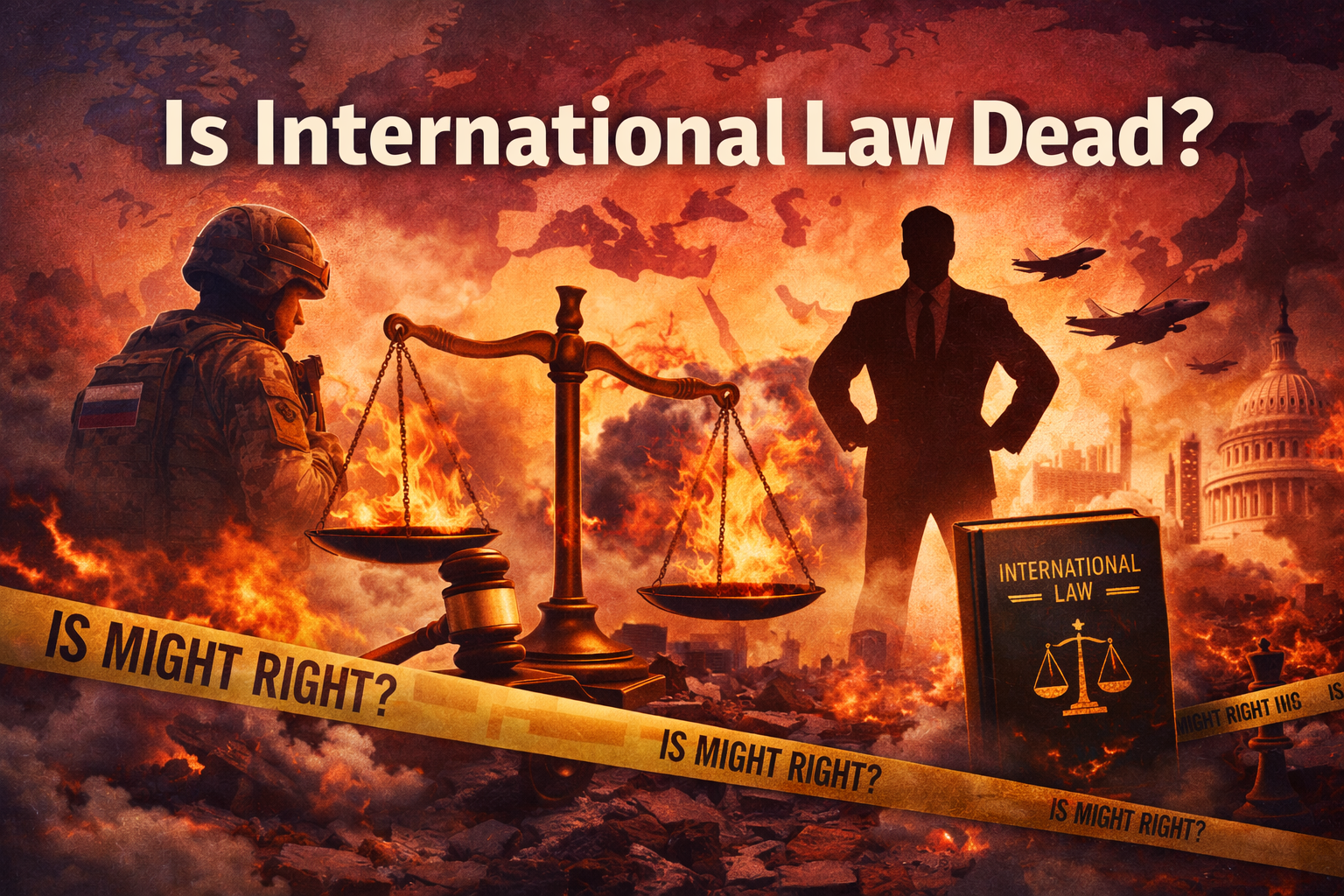
From the invasion of Ukraine to strikes in the Middle East and controversial U.S. extraterritorial actions, a chilling question is rising in global discourse: Is International Law Dead? And: Has international law lost its meaning?
This article will analyze the question: Is International Law Dead? by examining the dynamics of international law and how it has operated and functioned alongside power politics from inception.
Read: 9 Ways To Make A Judge Rule In Your Favor
When powerful states act without immediate consequence, it is easy to conclude that “might is right” has finally replaced the rule of law.
However, what we are witnessing is not necessarily the death of the legal order, but a violent tension between legal norms and geopolitical power.
The Paradox of Legitimacy: Why Even the Strong Play by the Rules
The concept of “rule by the strong” suggests that powerful states can act without any constraint. While enforcement gaps certainly allow major powers to push boundaries or delay accountability, a fascinating paradox remains: even when states violate international law, they still seek its legitimacy.
Powerful nations rarely admit to law-breaking; instead, they:
- Invoke the UN Charter to claim self-defense.
- Offer humanitarian or security justifications for their actions.
- Seek validation through international bodies like the United Nations.
This behavior proves that international law still frames global behavior—even when it is being bent or violated. Historically, even during the Cold War—a peak era of power politics—international law continued to regulate treaties, govern diplomacy, and provide standards for conflict.
A System Built on Restraint—But Lacking a “Police Force”
The modern global order is anchored in the UN Charter, specifically Article 2(4), which prohibits the use of force against the territorial integrity of states. This principle was designed to end the era where war was a legitimate policy tool.
However, unlike domestic law, this system lacks a central enforcement authority or a global police force. It relies heavily on state consent, diplomacy, and the collective will of the international community. This structural weakness becomes glaring when powerful nations defy the rules.
Geopolitical Stress Tests: Russia, the U.S., and the Middle East
Current global conflicts are stretching legal doctrines to their breaking points:
- Russia and Ukraine: The invasion is a clear breach of the UN Charter’s prohibition on force. While the International Criminal Court (ICC) has issued warrants for alleged war crimes, enforcement has been limited to economic sanctions and diplomatic isolation because the system struggles to stop a major power in real-time.
- U.S. Extraterritorial Actions: Operations involving the targeting of foreign leaders or extraordinary renditions raise serious questions regarding sovereignty principles and human rights law. Accountability remains elusive as powerful states often resist jurisdiction or see their domestic courts defer to executive authority.
- Preemptive Self-Defense in the Middle East: Recent strikes involving Israel, Iran, and the U.S. highlight a dangerous “gray zone”. International law permits force only when an attack is imminent, yet states increasingly justify actions based on future or speculative threats, stretching the doctrine of preemptive self-defense beyond its original meaning.
The Structural Imbalance: The Veto Power
The United Nations Security Council was designed to reflect power realities, which is why major states were granted veto power.
Today, this creates a fundamental imbalance: powerful nations can block enforcement or shield their allies from consequences, while smaller, more vulnerable nations are more likely to be held to the letter of the law.
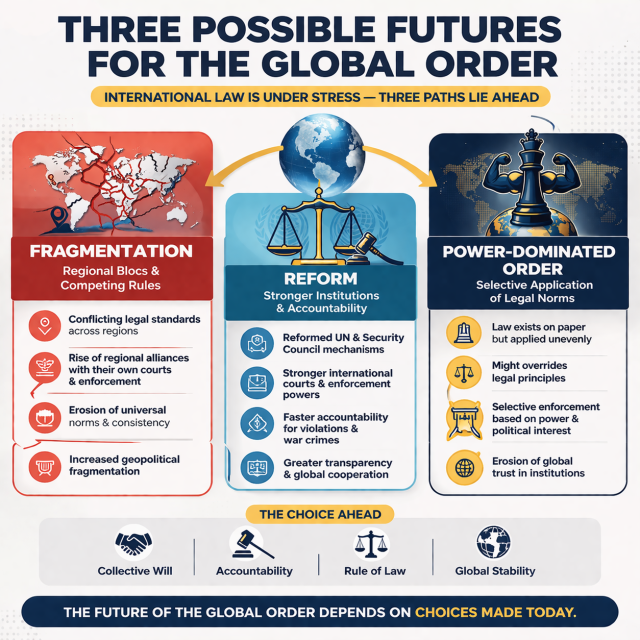
Three Possible Futures for the Global Order
International law is not currently dying; it is undergoing a rigorous stress test. As we look ahead, three possible futures are emerging:
- Fragmentation: Regional blocs begin enforcing their own conflicting versions of international law.
- Reform: The creation of stronger accountability mechanisms and reformed international courts.
- Power-Dominated Order: A world where legal norms exist on paper but are selectively applied based on who holds the most power.
Conclusion: A Question of Collective Will
International law does not eliminate power; it attempts to regulate it. When powerful states act unlawfully, the system appears weak, yet the global condemnation of these violations suggests that international law still matters.
The real question for the future is not whether international law is dead—but whether the international community possesses the collective will to enforce it equally across all nations, regardless of their strength